
Sourdough Resurrection Rolls (Empty Tomb Rolls) for Easter
Make a healthier version of a fun Easter treat, Sourdough Resurrection Rolls with this recipe!
At Easter time, resurrection rolls (also called empty tomb rolls) are delicious and serve as a great hands-on way to show kids why we celebrate resurrection Sunday.
In this post learn how to make these delicious completely homemade resurrection rolls with my Sourdough Sweet and Soft Bread Master Recipe.

What are Resurrection Rolls?
I began seeing this type of Easter treat circulating online about 8 years ago or so.
Most versions use a tube of dough from the grocery store like crescent rolls or biscuit dough.
The marshmallow represents Jesus’ body after His death on the cross that was embalmed with oils (represented by the melted butter) and spices (represented by the cinnamon sugar mixture).
The marshmallow coated in melted butter and cinnamon sugar is wrapped with a portion of dough and sealed to represent the tomb.
Once all the rolls are made and sealed, they are baked in the oven.
While the resurrection rolls bake, the marshmallow dissolves into sweet sugar that coats the inside of the roll.
After the sweet rolls are baked and cooled, you can cut one open or bite into it to reveal the empty tomb.
The body of Jesus (represented by the marshmallow) is gone!

Resurrection Rolls are a Fun Easter Activity for Kids
This is a great recipe and activity to do with your kids during Holy week or on Easter Sunday.
Young kids love hearing the story of Easter as told through this symbolic activity.
And this recipe is very forgiving for little hands.
The whole family can enjoy this Easter tradition that celebrates the resurrection of Jesus with delicious rolls!

How to make Sourdough Resurrection Rolls
The process of making this sourdough cinnamon roll recipe has the following steps: Ingredients, Starter preparation, Making the dough, Kneading, Bulk fermentation, Shaping, Baking, Cooling.
Ingredients
As I mentioned, the base enriched dough is my Sourdough Sweet and Soft Bread Master Recipe so it is easy to make and very adaptable. Here’s a video about the master dough recipe:
Here are the ingredients you will need:
- Starter preparation
- 15-20g (1 T.) sourdough starter
- 60 grams (7 tablespoons) all-purpose or bread flour
- 60 grams (1⁄4 cup) water
- Dough ingredients
- 100g* (1/4 c. and 2 T.*) whole milk, warmed (see step 2)
- 40g (2 T. and 2 t.) water
- 30g (2 T.) white cane sugar
- 100g (about 1/2 cup) active sourdough starter
- 375g (2 1/2 cups) all purpose flour. (see Tips section below)*
- 4g (1 t.) vanilla
- 7g (1 t.) salt
- 1 egg
- 45g (3 T.) unsalted butter, softened
- Resurrection roll filling ingredients
- 1/4 c. unsalted butter, melted
- 1/4 c. white cane sugar
- 1 t. cinnamon
- 9 large marshmallows
Helpful Tools
Some of the following are affiliate links. Read my policy here.
- Kitchen Scale
- Mixing Bowl
- Rounded dough scraper
- 4-qt. cambro for bulk ferment/first rise or non-plastic bowl covers
- 2 small bowls
- Large Spoons
- Rolling pin
- Parchment paper
- Baking sheet
- Rolling pizza cutter
Starter Preparation for Sourdough Resurrection Rolls
You will need a healthy, established sourdough starter for making this recipe. If you need to buy one or make one, here are my resources to get started!
With your sourdough starter, you can use active sourdough starter or sourdough starter discard, add one tablespoon to a container that is at least 1-pint in size. Then feed it with water and all-purpose flour. You can use bread flour instead, I use all-purpose flour because it is less expensive for this step.
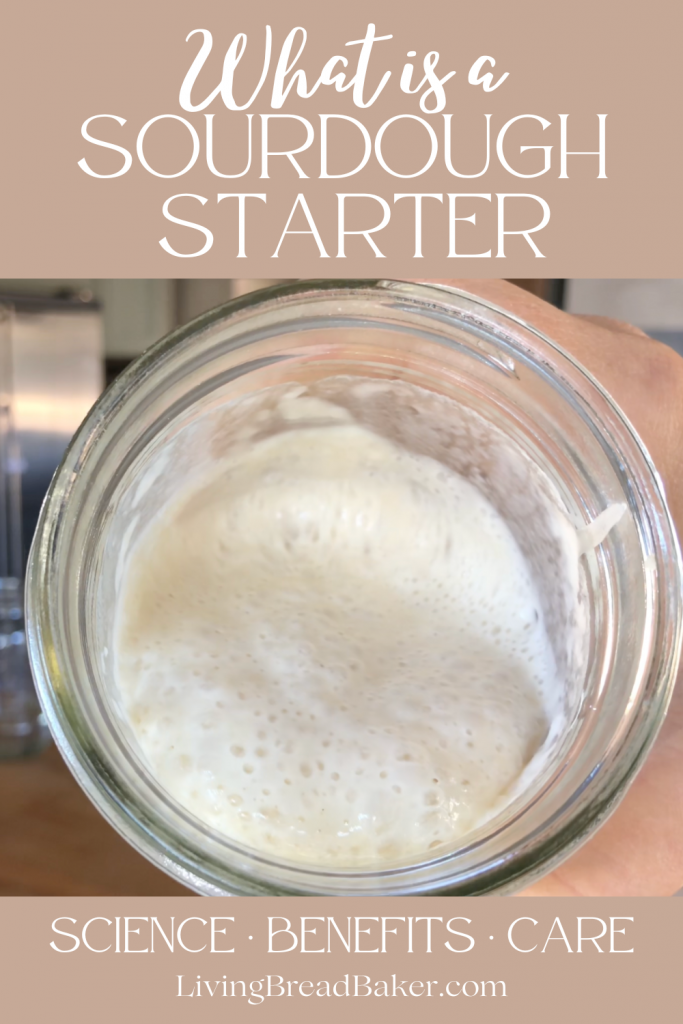
Let the starter sit at room temperature for 6 to 12 hours until it is doubled in volume, full of large bubbles, and smells fragrant like ripe fruit. See this post to learn more about what an active sourdough starter looks like: What is a sourdough starter?
The time range will depend on the room temperature in your kitchen, starting temperature of ingredients, and weather.
Making the Sourdough Resurrection Rolls Dough
Provided that your starter is active and ready, the first step to prepare the dough is scalding the milk. This neutralizes proteins in the milk that can conflict with good fermentation.
Add more whole milk than the recipe calls for to allow for evaporation. Heat the milk over medium to medium-high heat until it is steaming and proteins begin to stick to the pot. Temperature will be 130 to 140 degrees F. Don’t let it foam.
Transfer 100g of your scalded milk to the bowl of a stand mixer, large bowl, or a separate glass carafe to cool down to 90-100 degrees F.
While it’s cooling, use a separate large bowl to mix together the flour and salt.
Once your milk is cooled and in the bowl of a stand mixer or large mixing bowl, add the water, sugar, 100g of the active sourdough starter, and flour mixture. Stir with a dough hook attachment about 4 times around the bowl or with a large spoon if you are mixing by hand for 1 to 2 minutes until ingredients are beginning to combine and it looks like a shaggy dough mixture. Add the vanilla and egg. Continue mixing the dough until it becomes completely combined and soft.
Kneading the Sourdough Resurrection Rolls Dough
Once all the ingredients except the softened unsalted butter are added, it is time to knead your dough into a smooth, soft ball.
When using a stand mixer, use low to medium-low speed (I recommend the lowest 2-3 speeds) to knead your dough. It will take 5 to 8 minutes to get combined and soft until it pulls away cleanly from the sides of the bowl. Kneading by hand will take 8 to 12 minutes.
Now, it is time to knead in the softened unsalted butter. Add it one tablespoon at a time with kneading in between each addition.
Continue kneading until the butter is completely incorporated into your dough and it pulls away cleanly from the sides of the bowl or kneading surface and is a soft smooth ball.
Bulk Fermentation for Sourdough Resurrection Rolls
Place your dough into an airtight container or use a large clean bowl covered with plastic wrap.
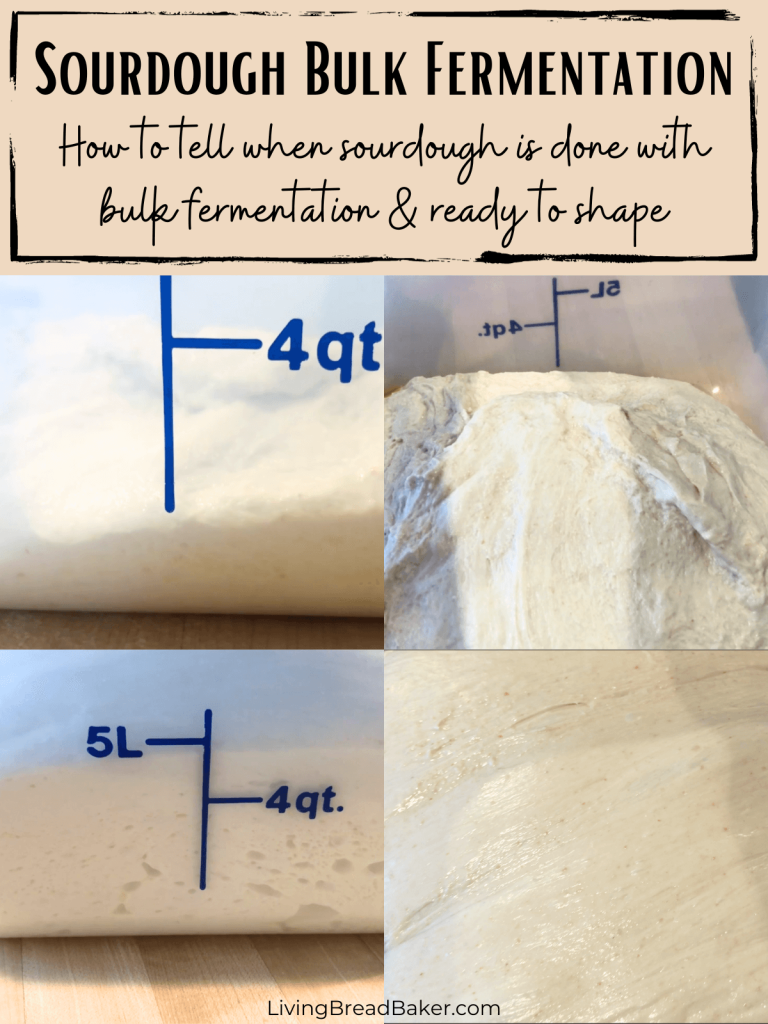
I like to use a 4-qt Cambro container like this one for bulk fermentation because it is easy to use and see the dough rise and gauge when the dough has doubled in volume.
Keep your dough at room temperature for 4 to 8 hours for the bulk fermentation or first rise until it doubles.
This is the only rise in this resurrection roll recipe so make sure it fully ferments for the best texture.
For clarity on when this stage is done, see this post.
Filling Preparation for Sourdough Resurrection Rolls
Melt the butter
In a small saucepan, melt the butter and put it in a small bowl to cool.
Make the cinnamon-sugar mixture
In a small bowl, mix the sugar and cinnamon until they are combined.
Roll out the dough
Prepare a baking sheet by lining it with parchment paper.
Place the dough on a lightly floured surface and use a lightly floured rolling pin to roll the dough into a circle that is 11-12 inches wide.
Use a rolling pizza cutter or a knife to cut the circle into thirds and then cut each third portion into thirds again to create 9 wedges of dough that are about equal in size.

Put as many of the triangles of dough* onto your lined baking sheet as you can fit and bring them over to a dining table along with a bowl of large marshmallows, the bowl of melted butter, and the bowl of cinnamon sugar.
With all the ingredients at the level for kids to participate, you’re ready to make these special Easter rolls!
*The other triangles of dough can be brought to the table once there’s more room.
Shaping Sourdough Resurrection Rolls
You can have kids make the rolls all at once, but I’ve found that it is best to demonstrate how to shape the first one as they watch, then help them make one, and finally give them the freedom to try on their own.
Before you begin shaping, make sure to preheat your oven to 375 degrees F since they will go directly into the oven after shaping without the typical proofing time.
- Take a marshmallow and roll it in the butter until it is completely covered.

- Place the butter coated marshmallow on the larger end of the triangle of dough.
- Take a spoon (about a teaspoon to half tablespoon size) and scoop up the cinnamon sugar and sprinkle over the marshmallow until it is covered.

- Take the two ends of the base of the triangle and fold them to meet one another and pinch them together to create a seam.

- From that wider end, roll the dough coated marshmallow up the tip of the triangle and then pinch any opening to completely seal the marshmallow into the dough.
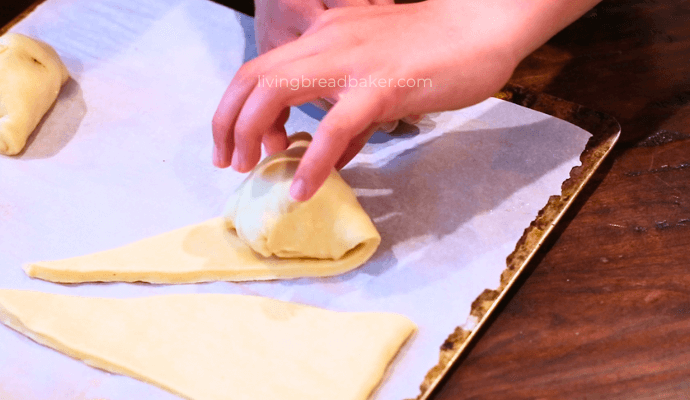

- Place the marshmallow filled roll onto the parchment lined baking sheet.

- Repeat with the rest of the dough and marshmallows until all the rolls have been made.
Baking Sourdough Resurrection Rolls
Once they look slightly golden and baked, turn your oven to 375 degrees F on the convection setting.
This allows the air to circulate more and gets each roll to have an ideal light golden brown color.
Bake for 1 to 2 minutes with the convection setting.
Cooling Sourdough Cinnamon Rolls
Then serve! They taste so good when they are warm and freshly baked.
I love to cut one in half to show my kids that the inside is empty just like the tomb on Easter morning.
Savor and Share
This is a wonderful way to celebrate the true meaning of Easter so make sure to share it with a friend!
The soft dough of the sourdough makes this recipe version extra special.
It takes a bit more time than using store bought crescent roll dough, but I love the texture and flavor of using my own dough.
I find that it is less greasy, delicious, and healthier.
After you try it, send me a note, leave a review comment, or tag me on facebook or instagram @livingbreadbaker
I would love to see your family enjoying this tradition together!
Happy Easter to you! He is risen!!
More Easter recipes
- Sourdough Hot Cross Wreath Bread for Easter
- Sourdough Easter Egg Bread (Pane di Pasqua)
- Sourdough Orange Cranberry Hot Cross Buns
- Soft, Fluffy Sourdough Discard Sugar Cookies
Other recipes using this master dough recipe
Don’t forget that the base dough can be used for so much more! Check out the post on how to use this versatile dough here:
- Easy Sweet & Soft Sourdough Bread Master Recipe
- Easy & Soft Savory Sourdough Cheese Twist Rolls
- Skillet Sourdough Apple Cinnamon Swirl Bread Recipe
Just getting started with sourdough?
A competent guide transforms sourdough baking from overwhelming to uncomplicated and fun!
Get My Free Quick Start Sourdough Guide: Learn the key terms and concepts in sourdough baking, including the differences between active sourdough starter and sourdough discard, and how to care for your starter.
Start Baking Sourdough Confidently—Take the Intro to Sourdough Course for Just $27!
Time Planning Help for Sourdough Baking
The #1 need for sourdough bakers is help with time planning, so I created a resource for you.
Sourdough Time Planning Workbook: Perfect for new or experienced bakers, this workbook includes 8 templates ready to fill in and a baking journal. The templates cover 4 different ways to make classic sourdough country breads, 3 time planning worksheets for enriched sourdough bread depending on serving time target, and a blank template. The baking journal goes over baker’s percentages and how to take notes on your sourdough bakes.
Get a free sample of the workbook: Use this sourdough time planning worksheet sample to simplify your baking.
Living Bread Baker posts mentioned
When is sourdough bulk fermentation finished?
When is sourdough finished proofing?
Sourdough Hot Cross Wreath Bread for Easter
Sourdough Orange Cranberry Hot Cross Buns
Soft, Fluffy Sourdough Discard Sugar Cookies
Sourdough Easter Egg Bread (Pane di Pasqua)
Easy Sweet & Soft Sourdough Bread Master Recipe
Skillet Sourdough Apple Cinnamon Swirl Bread Recipe
Easy & Soft Savory Sourdough Cheese Twist Rolls
Shop this post
Earlywood Designs French rolling pin
Ground cinnamon, organic (Vietnamese with higher oil content for more intense flavor)
FREE Sourdough Quick Start Guide
Sourdough Time Planning Workbook & Baking Journal
My Intro. to Sourdough online course
This post contains affiliate links. Read my policy here.

Sourdough Resurrection Rolls
Ingredients
Starter preparation
- 15-20 g 1 T. sourdough starter
- 60 grams 7 tablespoons all-purpose or bread flour
- 60 grams 1/4 cup water
Dough ingredients
- 100 g whole milk warmed 1/4 c. and 2 T.* (see step 2)
- 40 g water 2 T. and 2 t.
- 30 g sugar 2 T.
- 100 g active sourdough starter about 1/2 cup
- 375 g all purpose flour (see Tips in master recipe post here) 2 1/2 cups
- 4 g vanillla 1 t.
- 7 g salt 1 t.
- 1 egg
- 45 g 3 T. unsalted butter softened
Resurrection roll filling ingredients
- 1/4 c. unsalted butter melted
- 1/4 c. white cane sugar
- 1 t. cinnamon
- 9 large marshmallows
Instructions
Starter Prep
- Put one tablespoon of sourdough starter into a clean container or pint size jar. Feed it with 60g water and 60g white flour. Stir until no dry flour is left. Let it sit at room temp 6-12 hours until active (doubled in volume, full of large bubbles, and smells fragrant like ripe fruit)
Making the Dough
- Scald the milk: *Add more whole milk than the recipe calls for to allow for evaporation. Heat the milk over medium to medium-high heat until it is steaming and proteins begin to stick to the pot. Temperature will be 130 to 140 degrees F. Don't let it foam. Transfer 100g of your scalded milk to the bowl of a stand mixer, large bowl, or a separate glass carafe to cool down to 90-100 degrees F.
- Once your milk is cooled, add it to the bowl of a stand mixer or large mixing bowl, add the water, sugar, 100g of the active sourdough starter, and flour mixture. Stir with a dough hook attachment about 4 times around the bowl or with a large spoon if you are mixing by hand for 1 to 2 minutes until ingredients are beginning to combine and it looks like a shaggy dough mixture. Add the vanilla and egg. Continue mixing the dough until it becomes completely combined and soft.
Kneading the Dough
- Knead your dough into a smooth, soft ball. It will take 5 to 8 minutes to get combined and soft until it pulls away cleanly from the sides of the bowl. Kneading by hand will take 8 to 12 minutes.
- Now, it is time to knead in the softened unsalted butter. Add it one tablespoon at a time with kneading in between each addition. Continue kneading until the butter is completely incorporated into your dough and it pulls away cleanly from the sides of the bowl or kneading surface and is a soft smooth ball.
Bulk Fermentation
- Place your dough into an airtight container or use a large clean bowl covered with plastic wrap. Keep your dough at room temperature for 4 to 8 hours for the bulk fermentation or first rise until it doubles.
Filling and Shaping
- In a small saucepan, melt the butter and put it in a small bowl to cool.
- In a small bowl, mix the sugar and cinnamon until they are combined.
- Prepare a baking sheet by lining it with parchment paper.
- Place the dough on a lightly floured surface and use a lightly floured rolling pin to roll the dough into a circle that is 11-12 inches wide.
- Use a rolling pizza cutter or a knife to cut the circle into thirds and then cut each third portion into thirds again to create 9 wedges of dough that are about equal in size.
- Put as many of the triangles of dough* onto your lined baking sheet as you can fit and bring them over to a dining table along with a bowl of large marshmallows, the bowl of melted butter, and the bowl of cinnamon sugar.
- Before you begin shaping, make sure to preheat your oven to 375 degrees F since they will go directly into the oven after shaping without the typical proofing time.
- Take a marshmallow and roll it in the butter until it is completely covered. Place the butter coated marshmallow on the larger end of the triangle of dough. Take a spoon (about a teaspoon to half tablespoon size) and scoop up the cinnamon sugar and sprinkle over the marshmallow until it is covered.
- Take the two ends of the base of the triangle and fold them to meet one another and pinch them together to create a seam. From that wider end, roll the dough coated marshmallow up the tip of the triangle and then pinch any opening to completely seal the marshmallow into the dough. Place the marshmallow filled roll onto the parchment lined baking sheet.
- Repeat with the rest of the dough and marshmallows until all the rolls have been made.
Baking and Cooling
- Place your rolls into the hot oven to bake for 14 to 17 minutes. Once they look slightly golden and baked, turn your oven to 375 degrees F on the convection setting. Bake for 1 to 2 minutes with the convection setting.
- Cool these rolls on a cooling rack for at least 5 minutes. Then serve!





Where’s the “tips section” you asked us to see for a further explanation of the 375g flour?
It is in the master recipe post here: https://livingbreadbaker.com/simplesweetsourdoughmaster/
I love resurrection buns, thank you for sharing your recipe! However, I read through the directions several times and never saw a step to add the 40 g of water. Unfortunately, I created a dough-brick and then tried to add the water at the end. I assume the water was meant to be included at the beginning with the milk/sugar/flour, so be sure to update your instructions to help others avoid the same mistake!
Hi Kate,
I’m sorry about that! In the master recipe it discusses when to add the water. So I’ve added that to this spin-off recipe for future reference. Hopefully your dough still came together after kneading, I know I’ve had to do that before.
The ingredients list 40g water but the recipe does not state when to add that. Is it with the milk? When everything goes on the mixer? Or it was meant for the sourdough starter and not the dough?
Thanks!
Hi Deb, yes with the milk.
I must have an “updated recipe” since I do see when to add the water, however, I didn’t see when to add the salt. I read through over and over and couldn’t find it. I just added it with the flour and it turned out great.
Very fun with the kids. Thanks so much.
I’m so glad you enjoyed it Heather!